




Mango cultivation is deeply woven into the agricultural economy of the erstwhile Chittoor region of Andhra Pradesh, an area widely recognised for its large-scale mango production. However, farmers in the region face a growing set of challenges, ranging from erratic weather and prolonged dry spells to pest and disease pressure, ageing orchards and inadequate adoption of scientific crop management practices.
Against this backdrop, Project Unnati Mango is working to bring scientific cultivation practices directly to farmers' fields. The initiative focuses on improving productivity, conserving water, strengthening soil and plant health, and enhancing the quality and economic returns from mango cultivation.
In an interview, Dr. S. Sreenivasulu, Senior Scientist and Head, RASS-Krishi Vigyan Kendra, Tirupati, explained the challenges faced by mango growers, the interventions being promoted under the project and the measurable impact of adopting improved cultivation practices.
Tackling the productivity challenge
The erstwhile Chittoor district is one of India's major mango-producing regions, with the Totapuri variety accounting for a dominant share of the cultivated area. Despite its importance, productivity remains significantly below the crop's potential.
According to Dr. Sreenivasulu, Totapuri mango generally produces around 4-5 tonnes per acre under average conditions, while the potential yield can reach approximately 8-10 tonnes per acre under better management.
Several factors contribute to this productivity gap. Erratic weather, delayed and irregular monsoon rainfall, prolonged dry spells and inadequate orchard management can severely affect flowering, fruit setting and final yields. In difficult years, production can decline substantially compared with normal harvests.
Project Unnati Mango seeks to address these challenges through an integrated approach rather than relying on a single intervention.
Bringing scientific management to farmers' fields
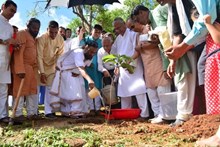
The project began its implementation during 2025-26, with capacity-building programmes conducted across selected mandals with significant mango acreage.
Farmers have been trained in integrated nutrient management, integrated pest and disease management, water conservation, pruning, intercropping and orchard management. Training has been designed to cover the complete production cyclefrom field preparation to harvesting and post-harvest management.
A major focus has been placed on soil-test-based nutrient management. Soil samples were collected from identified farms and farmers were encouraged to apply fertilisers according to soil-test recommendations rather than following blanket application practices.
The project has also conducted field demonstrations on top-working and rejuvenation of old and unproductive mango trees. Through top-working, poorly productive trees can be converted into productive trees, while rejuvenation helps restore ageing orchards and extend their economic life.
To support these interventions, farmers were provided with critical inputs, grafting material and equipment, along with skilled manpower and continuous technical guidance from the Krishi Vigyan Kendra team.

Fruit fly: A major threat to mango production
Among the major constraints faced by mango growers in the region, the fruit fly stands out as one of the most serious.
Dr. Sreenivasulu highlighted that fruit fly infestation can cause severe losses, particularly in Totapuri orchards. Under the project, farmers were trained in the installation and use of fruit fly traps.
Field demonstrations helped farmers understand where and how the traps should be installed and the benefits of using them as part of an integrated pest management strategy.
The intervention helped reduce fruit fly infestation and contributed to improved crop performance in participating orchards.
Integrated pest and disease management
Project Unnati Mango also emphasises the early identification and scientific management of pests and diseases.
Farmers received training to identify common mango pests such as hoppers, thrips and fruit flies, as well as diseases including powdery mildew and anthracnose.
The emphasis is on adopting appropriate management practices at the right crop stage and reducing unnecessary dependence on chemical pesticides.
Bio-based inputs have also been promoted. The project supplied biofertilizer and biopesticide-based solutions and conducted demonstrations to explain their proper application, timing and dosage.
According to Dr. Sreenivasulu, these interventions helped farmers manage pest and disease pressure while supporting better crop growth and fruit development.
Better nutrition, better fruit quality
Nutrient management is another important component of the project.
Farmers were encouraged to follow soil-test-based fertiliser recommendations and were also trained in foliar nutrient application at important stages of crop development. Biofertilisers were demonstrated and supplied as part of the intervention.
The objective was not simply to increase the quantity of mangoes produced, but also to improve fruit size, weight, colour and shelf life.
The project assessment supports this approach. Demonstration farms recorded a 17.15% increase in fruit size and an 18.95% increase in fruit weight compared with conventional farmer practices.
Such improvements are particularly important because fruit quality directly influences market acceptance and, consequently, farmers' returns.
61.9% improvement in fruit yield
One of the most significant findings from the project has been the improvement in productivity.
According to the project assessment, the demonstration farms recorded a 61.9% improvement in fruit yield compared with conventional farmer practices. This translated into an additional net return of approximately ₹44,336 per acre.
The results indicate that scientific orchard management can generate substantial economic benefits when multiple interventions are adopted together.
Rather than depending on one technology, the project combines improved nutrition, pest and disease management, water conservation, pruning, rejuvenation, top-working and farmer training.
Demonstrating success through farmers
The project has worked with a large number of farmers across mango-growing mandals of the region. Farmers including Chittibabu Naidu, Nageswar Raju, Reddenna, Iragam Reddy, Vasu and Murali Krishna, among others, have adopted various practices demonstrated under the programme.
The project has also established demonstration farms to allow farmers to observe the impact of improved practices under field conditions.
More than 5,000 farmers have benefited directly or indirectly, while improved cultivation technologies have been adopted across more than 400 hectares, equivalent to approximately 1,000 acres, according to the project assessment.
For agricultural extension, such demonstrations are important because farmers can see the benefits of a technology before adopting it on a larger scale.
From demonstrations to wider adoption
Project Unnati Mango has also used field days, exposure visits, method demonstrations and other extension activities to disseminate the results of the interventions.
The objective is to ensure that the knowledge generated through demonstration farms does not remain limited to participating farmers. Instead, successful practices can gradually spread to other mango-growing farmers across the district.
This approach combines scientific knowledge with farmer-to-farmer learning, creating greater potential for wider adoption.
The road ahead: Climate-smart mango cultivation
Looking ahead, Dr. Sreenivasulu believes that the lessons from Project Unnati Mango can be taken to other mango-growing regions of Andhra Pradesh.
The future focus of the initiative is expected to include climate-smart cultivation, digital crop advisory systems and rejuvenation of ageing orchards.
The project also plans to strengthen demonstration farms and increase the role of Farmer Producer Organisations (FPOs). Specialised training programmes can further strengthen farmers' capacity to adopt scientific cultivation practices.
The larger objective is to develop a scalable model that can help mango farmers improve productivity, fruit quality, climate resilience and farm-level returns.
A scientific pathway for the mango sector
The experience of Project Unnati Mango demonstrates that improving mango productivity is not simply about introducing a new input or technology. It requires a combination of soil health management, efficient water use, balanced nutrition, pest and disease management, orchard rejuvenation, farmer training and continuous technical support.
With climate variability increasingly affecting agriculture, such integrated approaches could become particularly important for perennial crops such as mango.
The results from Project Unnati Mangoparticularly the reported improvement in fruit yield, quality and net returnssuggest that science-based orchard management can provide farmers with a practical pathway towards more productive and resilient mango cultivation.
For the mango farmers of Andhra Pradesh, the next phase will be about taking these lessons beyond demonstration farms and scaling them across the state's diverse mango-growing regions.